Every Child Achieving and Thriving
The government’s new SEND white paper makes a promise that is hard to argue with: every child, including those with special educational needs and disabilities, should be supported to achieve and thrive in mainstream education.
Much of the focus is rightly on improving support within schools, through better training, clearer standards, and additional funding. These are important steps. But they rely on an assumption that all schools are working with a broadly representative intake of pupils.
In practice, this is not the case.
Tweaks within an unequal system
The white paper acknowledges that “more could be done to reduce barriers in the system, particularly for children from disadvantaged backgrounds, and children with SEND.” It proposes a future consultation on the School Admissions Code, including improvements to fair access protocols and greater transparency around fair banding admissions.
These are welcome changes. But they are proposals to adjust the edges of a system that is unequal at its core.
The current admissions framework already allows schools to adopt more inclusive practices, for example, by prioritising pupils eligible for the pupil premium. Yet these tools are unevenly used, and sit alongside arrangements that actively limit access for pupils with SEND.
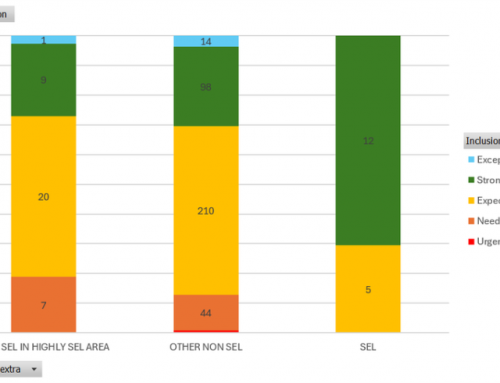
Grammar schools are the clearest example. In selective areas, grammar schools admit around 4.3% of pupils with SEND, compared to 15.5% in non-selective schools in the same areas. This is not an accident of implementation. It is a structural consequence of academic selection. Grammar schools cannot admit a representative SEND intake by design, the selection process filters them out before the school has any say.
The result is that non-selective schools in grammar school areas carry a disproportionate share of the challenge. That is not a fair basis for a system built on shared responsibility.
Why this matters for the reforms themselves
The white paper’s proposals for local SEND partnership groups, pooled funding, and shared inclusion standards are built on an idea of schools working together to meet the needs of children in their area. That is the right idea. But collaboration is much harder to sustain where intakes are not balanced.
If some schools admit very few pupils with SEND while others support a much higher proportion, the partnership model starts to fracture. Inclusion becomes something delivered by certain schools, rather than a genuine commitment shared across all of them.
And this is not only a question of fairness between institutions. For families, inclusion does not begin with the support offered once a school place is secured. It begins with the ability to access a suitable local school in the first place.
What needs to happen
The white paper signals that admissions reform is coming. That consultation should do more than adjust banding rules or improve in-year processes, useful as those changes may be.
It should explicitly include selective schools in scope, so that admissions policy and SEND reform are genuinely aligned. It should require all schools to admit a broadly representative intake of pupils with SEND, so that responsibility for inclusion is shared fairly. And it should review admissions arrangements, including selective testing and complex oversubscription criteria, that may be reducing access for pupils with additional needs.
Inclusion cannot be delivered solely through what happens inside the classroom. The white paper understands this in principle. The test will be whether the admissions consultation follows through.
Comprehensive Future’s response to the “Every Child Achieving and Thriving” consultation
In areas with grammar schools, selective schools admit significantly lower proportions of pupils with SEND (around 4.3%, compared to 15.5% in non-selective schools in the same areas). This is a structural consequence of academic selection. Grammar schools cannot admit a representative SEND intake by design. The result is that responsibility for inclusion is concentrated in the non-selective schools wherever a grammar school is located, undermining the shared accountability this consultation seeks to build.
This matters directly for the partnership model proposed here. Local SEND groups and pooled funding depend on schools sharing responsibility fairly. Where intakes are highly uneven, that collaboration becomes harder to sustain.
We call for the forthcoming admissions consultation to explicitly include selective schools in scope, so that admissions policy and SEND reform are genuinely aligned. It should require all schools to admit a broadly representative intake of pupils with SEND, so that responsibility for inclusion is shared fairly, and review admissions arrangements that may disadvantage pupils with SEND, including selective testing and complex oversubscription criteria.
Inclusion begins at the school gate. Reforms that address only what happens inside classrooms, while leaving structural barriers to access unchanged, will not deliver the inclusive system this consultation promises.