
The largest recent study of academic selection in Northern Ireland finds little evidence that it improves outcomes or social mobility, and strong support for reform.

A major new study from Queen’s University Belfast, funded by the Nuffield Foundation, concludes that academic selection at age 10-11 contributes to educational inequality and puts unnecessary pressure on children and families. It also finds that the system survives more because of social and political factors than because of any evidence that it works.

The report, Exploring Academic Selection and Grammar Schools in Northern Ireland, is a comprehensive examination of selection in Northern Ireland. It combines documentary analysis, a systematic review of international evidence, and interviews and focus groups with more than 120 parents, school leaders, academics, education stakeholders and pupils.

Advantage concentrated, not spread

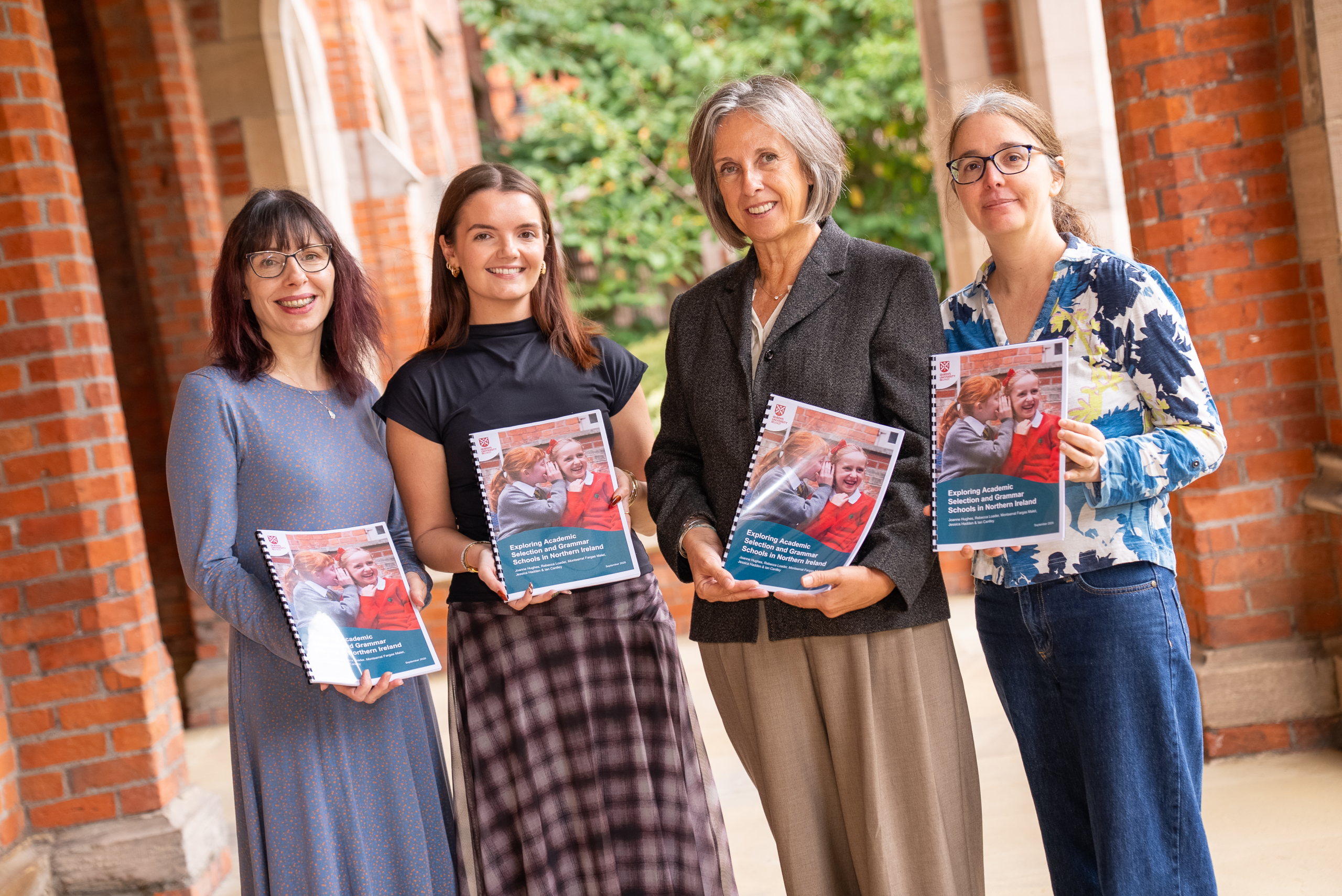
Pictured L-R are: Professor Rebecca Loader, Dr Jessica Hadden, Professor Joanne Hughes, and Dr Montserrat Fargas.

The researchers found that some grammar school pupils may see modest academic benefits. But they found little evidence that selection improves educational outcomes or social mobility across the population as a whole. Instead, the system concentrates advantage. Families with more economic, cultural and social resources are better placed to navigate admissions, pay for private tutoring and meet the extra costs of grammar school attendance.

The human cost was clear too. Pupils and families described heightened stress and anxiety around high-stakes testing at the end of primary school. Schools said preparing for the transfer test narrows the curriculum in Primary 6 and 7.

Why selection endures

The report finds selection remains deeply embedded because many parents, educators and pupils still see academic ability as a fixed, measurable trait that can be reliably assessed at 10 or 11. That belief underpins the idea that selective admissions are fair and meritocratic, despite extensive research showing that attainment is shaped by a wide range of developmental, social and contextual factors.

Lead author Professor Joanne Hughes said the research shows selection is “associated with wider educational inequalities and increased pressure on children and families, while offering limited evidence of improved social mobility.”

Strong support for reform

Among participants in the study’s deliberative event, 95% favoured reform. The most popular option was a move to an all-ability comprehensive system, backed by investment to make sure every school is well resourced. The report also considered transitional measures, such as delaying selection or admitting pupils on a broader profile, to reduce harm while change is under way.

Its recommendations include more investment in disadvantaged schools, redefining how school quality is measured, protecting the primary curriculum, reducing segregation and stigma between school sectors, and ultimately ending high-stakes selection at 10-11 within a carefully planned transition. The researchers stress the need to engage constructively with all stakeholders, including supporters of selection, and to build public understanding of the evidence.

What it means for England

Northern Ireland’s system differs in its details, but the findings will be familiar to anyone who lives in one of England’s selective areas. In Kent, Buckinghamshire, Lincolnshire and elsewhere, children still sit high-stakes tests at 10 or 11. Families with the means still turn to private tutoring. Primary schools still feel the pressure of test preparation. And the belief that ability can be sorted reliably at that age still underpins the whole system.

The study’s conclusion that selection concentrates advantage rather than widening opportunity matches what we see in England’s selective areas. So does its finding that the system persists through belief and habit rather than actual evidence.

The report echoes many of the findings of researchers studying England’s selective areas, including its challenge to the assumption that grammar schools’ results demonstrate greater school effectiveness. It says differences in outcomes are largely attributable to their intake of pupils.

One aspect of the study that has not been replicated in England, at least to our knowledge, was the presentation to stakeholder groups of different options for a reformed school system. It was interesting to see that the option that won the most support was ‘a system of all-ability comprehensive schools.’

As a member of the pupil focus group put it, “If all schools were just the same and equal, that would just be so, so much better.”

The full report is available at go.qub.ac.uk/ACADSELECTION.


The report also

Pressure on children and primary schools

Researchers found that high-stakes transfer tests can cause significant stress and anxiety for children and families. For some children who do not secure a grammar school place, the process can have lasting effects on confidence, self-esteem and their sense of themselves as learners.

Schools also reported that preparation for transfer tests narrows teaching in the final years of primary school, taking time away from the wider curriculum.

Despite these consequences, the researchers found that selection remains deeply embedded. Grammar schools retain considerable status, while many people continue to believe that academic ability is fixed and can be measured reliably at the age of 10 or 11. This helps the system appear fair and meritocratic even though children’s attainment is strongly shaped by their circumstances and development.

A route towards comprehensive education

There was strong support for reform among the study’s participants, with an all-ability comprehensive system attracting the greatest support. Only three research participants favoured retaining the present system.

The report recommends a programme of change including:

  • funding schools more fairly according to pupil need;
  • investing in schools serving disadvantaged communities;
  • measuring school quality through pupil progress, inclusion and wellbeing as well as raw results;
  • protecting the primary curriculum from excessive test preparation;
  • reducing segregation and the concentration of disadvantage;
  • strengthening oversight of admissions;
  • progressing towards an all-ability comprehensive system; and
  • ending high-stakes academic selection at 10 and 11.

Although the research concerns Northern Ireland, its conclusions will be familiar in selective areas of England. The success of an individual grammar school cannot be considered separately from the pupils it selects or the consequences for neighbouring schools and children who are not selected.

The report is a further reminder that selection does not create ability or opportunity. It sorts children—at a very young age—within a system in which some families have far greater resources than others. A fair education system should instead provide excellent, inclusive schools for every child.

Read the full Queen’s University Belfast report, the summary from the Nuffield Foundation and Queen’s University’s announcement.