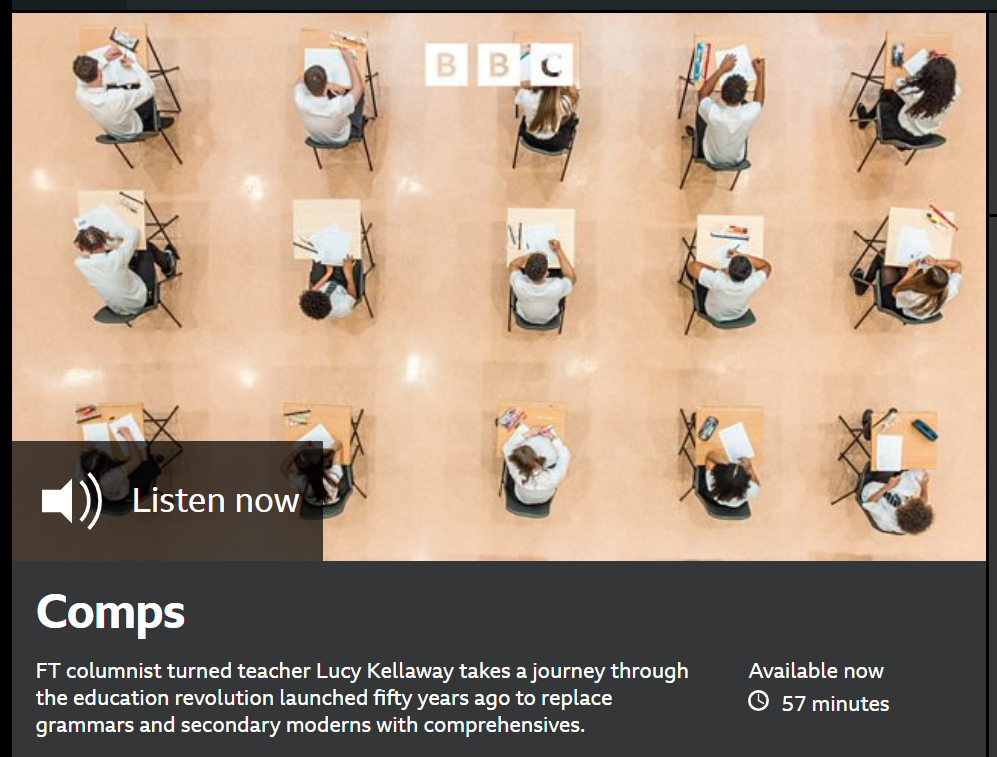
Image: BBC / Comps
By Alan Parker
Radio 4’s Comps was presented by Financial Times columnist turned teacher Lucy Kellaway. She explored the education revolution launched fifty years ago to replace grammars and secondary moderns with comprehensive schools.
The show ended on a genuinely good question. Lucy said comprehensive education asks for two things at once: to give all children the same opportunities, while recognising that no two children are the same. Like democracy, she suggested, perhaps it’s the least worst option we have: schools that not only educate children, but make citizens of them who stand a chance of rubbing along with each other throughout their lives.
Lucy Kellaway puts it almost exactly right. Everyone agrees on the basic idea – the same opportunities for every child, the benefits of recognising individual differences. The final moments pose an interesting and intriguing question, which could be summarised as: “If everybody agrees that the fundamental idea behind Comprehensive Education is right – which they do – why hasn’t it worked?” Unfortunately, that question is not addressed explicitly in the 55 minutes of content preceding it.
The tell comes when Fiona Millar says, in passing, that school admissions are a problem. She doesn’t get to finish the thought, before anyone can press her on it, the programme cuts to another contributor insisting it would be unrealistic to try to make every school a perfect microcosm of the population, because “bussing was tried in the USA and nobody liked it.” This may be true, as far as it goes. But it’s nothing to do with what Fiona Millar, or anyone else arguing for a genuinely comprehensive system, has ever proposed. It’s standing in for an answer, and then the subject changes, and the programme’s one moment of contact with the real issue concludes.
Comps keeps arriving at the edge of the actual explanation but then finds a reason to talk about something else instead.
Here’s the point it kept missing. A school only earns the description “comprehensive” if it is part of a wider “comprehensive system” were all schools, both individually and collectively, serve the whole community without anything filtering who arrives at the gate of any individual instituion.
The most important thing to understand about this debate is that most schools which carry the “comprehensive” label don’t meet that definition and therefore cannot properly be so described. This may be dismissed as semantics, but it is important for an understanding of why we are where we are.
In a very real sense, it is nearly impossible for an individual school to be a “Comprehensive School” in isolation. The term is only meaningful if the school in question is part of a coherent comprehensive system serving an entire community.
Although every comprehensive school has a “non-selective” admissions policy, not every non-selective school can be seen as truly “Comprehensive.” Other kinds of school are generally defined by the way they select their intake. Grammars select according to high academic ability; faith schools according to religious membership or observance; specialist schools by aptitude for a subject or area of study; and private schools according to the ability to pay. In an area served by a number of schools that select by different means there usually has to be at least one which will take everybody else. That school will be ‘non-selective’ by default, but it cannot properly be regarded as contributing to an effective comprehensive system. However, it will often be seen as a “comp” by the majority of the population – including, apparently, the makers of this programme. That is a problem that any serious approach to this issue should recognise and address.
The history bears this out, once you know what to look for.
The programme correctly traced the story back to the post-war tripartite system of grammar, technical and secondary modern schools. The 11-plus was supposed to diagnose the kind of education most suitable for each child rather than act as a simple “pass-fail” examination — and Comps found an excellent contemporary archive clip making precisely that argument.
But the system did not work as neatly as its designers hoped. Technical schools were never established on anything like the scale envisaged, while objections grew to selecting children’s educational routes at eleven. By the 1950s and 60s, local authorities were already developing alternative approaches, including Leicestershire’s community colleges and Cambridgeshire’s village colleges.
The move towards comprehensive education gathered pace, particularly after Labour’s Circular 10/65 asked local education authorities to plan for reorganisation.
But the process was never completed.
The result was a country in which most secondary schools became non-selective while grammar schools survived in some areas and other forms of selection remained. England moved a considerable distance towards a comprehensive system without ever actually arriving at one.
Then the direction changed again.
From the 1980s onwards, schools were increasingly encouraged to act as individual institutions competing for pupils, results and reputation. Funding linked to pupil numbers gave schools an obvious reason to compete for recruitment, while published examination results helped create an education market in which parents were expected to exercise “choice”.
The expectation was that competition would drive up standards.
Whatever view is taken of the success of those reforms in their own terms, they sit awkwardly with the idea of a comprehensive system as a collaborative public service in which local schools collectively meet the needs of all local children.
This goes directly to the phrase used in the BBC’s description of Comps: “when lofty ideals collide with reality, things don’t always turn out as planned.”
But the “reality” in question isn’t an inevitable force of nature. Much of it is a consequence of policy choices about admissions, school organisation and competition — and policy choices can be changed.
The programme itself identifies another important moment. When Labour returned to government in 1997 it chose to focus on “standards not structures”. David Blunkett explains why reopening battles over school organisation appeared politically difficult.
But “standards not structures” has always been a questionable distinction. Structures affect which children attend which schools, what challenges those schools face, and how improvements in education are distributed.
If structures help create unequal intakes, improving standards without addressing those structures will not necessarily improve children’s opportunities equally.
That is surely central to any attempt to understand why comprehensive education has not fulfilled all the hopes placed in it.
Instead, Comps spends considerable time on issues such as mixed-ability teaching and whether comprehensive education represents a “one size fits all” approach.
But mixed-ability teaching isn’t the defining feature of a comprehensive system. Comprehensive schools can set pupils for some subjects, teach mixed groups for others and offer different courses to different young people.
And equal opportunity does not mean pretending everybody is the same.
Quite the opposite. A comprehensive school serving a broad population should be able to offer variety and flexibility to pupils whose interests, aptitudes and needs change considerably between the ages of eleven and eighteen.
Selection doesn’t solve the problem that everybody is different. It simply divides a diverse population into smaller groups and sends those groups to different institutions.
There is also something revealing about the programme’s title. “Comps” carries some of the baggage of “bog-standard comprehensive”: the idea of comprehensive as shorthand for the ordinary school you attend when you haven’t obtained access to something supposedly better.
Lucy Kellaway clearly wants to challenge that assumption. Yet at times the programme risks reinforcing it.
And it’s worth saying that none of this argument applies to primary schools.
There is no general system of academic selection at five. Children of widely different abilities attend school together, usually relatively close to where they live, and nobody considers this an extraordinary educational experiment requiring constant justification.
We simply expect a primary school to educate the children who arrive.
Comprehensive education isn’t inherently a utopian idea that’s been tried and found wanting. For younger children, educating a broad range of pupils together is simply what we do.
It is when we reach secondary education — where selection, admissions differences and competition between institutions become much more significant — that we begin asking whether comprehensive education “works”.
So perhaps the question isn’t “why hasn’t the comprehensive ideal worked?”
Perhaps it is why, fifty years later, England is still judging comprehensive education on the results of an experiment it never quite completed.
If the BBC wants a second bite at this, the follow-up programme practically writes itself.
Go back to Fiona Millar’s interrupted sentence and take it seriously. Look at what school admissions actually do, why neighbouring schools can have very different intakes, what happens in the remaining selective areas, and whether a collection of nominally non-selective schools is necessarily the same thing as a comprehensive education system.
That would take Comps beyond the history of comprehensive schools to the interesting questions of: whether England has ever really had comprehensive education at all; and, more interesting still, what would be necessary to complete the transformation that was envisaged fifty years ago?
Comprehensive Future would be very happy to help.