By Mike Murray
The success of Andy Burnham’s education policy, led by Lucy Powell, is going to hinge on whether they can imagine and promote a comprehensive future, not a tripartite past. There is undoubtedly much to be hopeful about if they commit to finishing the comprehensive revolution which has unseated some of the fixed expectations of the former Tripartite (Grammar, Secondary Modern, Technical system) in most places in England. Andy and Lucy embody the success of the comprehensive system, the 93% of us who are not privately educated. But this vision of an education that seeks to meet the needs of all students, regardless of background, still faces serious obstacles if it is to come to fruition.
Devolving power to locality and place has always been at the heart of successful schools that can devote their attention to the context in which they operate. However, the chance of overcoming the low expectations of working class communities and generating high achievement are reduced by poor funding, selection and the extraction of the most able and aspirational to academic settings and the lack of local economic opportunity. Schools also require access to, and learning from, those who deal best with similar circumstances. Respect for ‘Place’ is crucial to developing pride in achievement and routes into local employment. A focus on ‘Place’ can create more meaningful control and governance and make a difference to everyday lives.
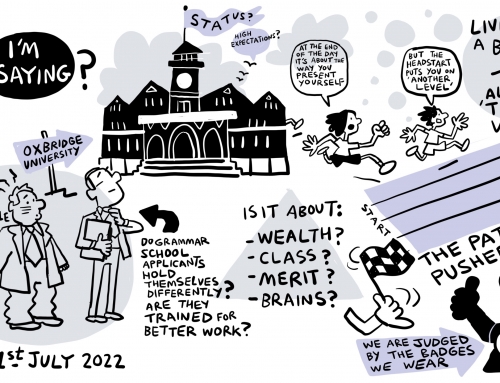
However, emphasis on ‘Place’ can be problematic if, for example, the local government is under the control of Reform or Conservative councillors who favour low local investment in state education, have a nostalgia for grammar schools, and only esteem the successful few in a narrow range of academic pathways. ‘Place’ can be problematic if you are a neglected coastal town, in rural isolation, a former mining village or mill town with little by way of access to the expensive resources required for some technical courses. The national government must set clear parameters for what sort of inclusive comprehensive education must be available in all localities. It must be brave enough to challenge nostalgia for a failed past system of labelling and selection which persists in many localities like Kent, Trafford, South Essex, Buckinghamshire and Lincolnshire to name but a few. These systems can reinforce class inequalities leaving many working class children labelled as academic ‘failures’ – a label they can carry for life. The government should complete the unfinished journey towards comprehensive schools and challenge the entrenched prejudice against them. London shows what higher state funding and highly aspirational communities can achieve but it cannot be easily and completely replicated in other places.
If technical and vocational education is to have credability it cannot be at the expense of academic excellence. Gove was right to insist that all state educated children need a strong foundation in subject excellence and most teachers will not be convinced that meaningless work-related courses are as valuable as the acquisition of academic skills. But his curriculum was too narrow, excluding arts based, humanities and practical pathways and based too much on information overload rather than exploring critical understanding. It has very much made worse the experience of the 30% who have been deemed to fail by a norm referenced exam system every year, and of the 70% facing a ridiculous examination paper overload at 16. Becky Francis’s sensible curriculum review should be allowed to rebalance this across and within subjects.
The definition of what constitutes technical or vocational must be broad and related to the society of today and its future. Tomlinson (2004) suggested 14 subject/disciplinary areas which related loosely to a range of employment sectors within 14-19 curriculum where a student could move from foundational to highly advanced competency. It would be useful to revisit something similar but updated for now and the future. Unpicking the academic from the practical is as unhelpful as knowledge from skills, as they are founded on each other. But practical application gives many a route into understanding more technical things. The key is to create broad and flexible routes that all allow progression from the foundational to the advanced, and do not shut off the chance to swap across areas or courses. Just as importantly, every young person should be able to move between subjects and courses without being limited by stereotypes or gender expectations, or steered towards low-paid employment.
This should be driven not by profit but need. We know we need all sorts of work done. We need to construct many more houses. We need to care for many more elderly people. We need to transition into cleaner energy. We need food security and biodiversity in an increasingly uncertain world. We need to repair the damage to our health that the destruction of the arts, music, community spaces has wrought on our lives. We need chefs and hairdressers and sports coaches. In short, we must prepare students for the industry and services we need now and in the future, not those of the past. This requires that the government encourage economic development across the whole country for all these needs not merely envision the technical as specific to large local industry. Of course, ensuring we still have a stake in the industries of the future is also vital. If meeting these needs is fostered across economic and social policy, then schools and colleges will readily follow, connecting students to those needs.
Any change towards more complex pathways needs to be accompanied by intelligent and proportionate accountability. Labour made a good start to reform of accountability by abolishing single grade OFSTED judgments. But the new OFSTED framework remains fixated on multiple norm-referenced judgments rather than how to raise the quality of education in whole regions, trusts or places. The incentives for schools to drive to recruit the right sort of student and leave their neighbours with more deprived students, SEN needs (diagnosed or not) and attendant difficulties is strongly embedded. Advisors for the DfE’s Regional Improvement for Standards and Excellence (RISE) programme are, at least, now brokering some resources to aid school improvement for some schools. We have seen in the past how overvaluing low-utility vocational courses within school accountability measures simply means schools will distort their curriculums to maximise their score. But not counting whole vital areas of education is unacceptable. Schools need to be credited for creatively working to establish education that meets the needs of all their students not just those that hit the measurements: their attendance, their engagement, their future employment, health and social contribution and a more balanced curriculum. Data needs to be used to compare similar contexts, not used to condemn those who are struggling with the most difficult ones to master. To fail with the difficult students should not be career ending or a matter for public shaming.
Esteem and value will not be driven by increasing the number of non-academic courses completed by the lowest attaining students in our cohorts. Esteem will be driven by creating purposeful futures for all our young people. The pandemic showed us the value of caring, of educating, of science, of foundational goods, secure housing, food security and of sociability. Teaching, medicine, construction, vaccine development, acting, hosting, delivery and distribution of vital goods and caring for vulnerable people all require technical skill and many different routes into employment. The work that creates the greatest social value has not always been rewarded with either money or status. To celebrate the contribution of the refuse collectors, bus drivers, shop workers and care assistants not just the accumulation of money must be at the heart of this policy.
Conservative education policy from 2010 to 2024 focused most on the academic aspect of education for those who could compete most to meet exam-based measurement, but it neglected the vocational, and education’s civic and democratic purposes. It is right that we rebalance this. They also deliberately and implicitly divided us into the winners and losers and pointed to the higher-funded, more cooperatively operating cities full of successful and ambitious immigrants as scapegoats for the underfunded and neglected places. They also chose to often ignore the need for a secure and sustainable future. These deniers of our present complexity will push a nostalgic story of the grammar school as an engine for social mobility and the technical school as a route into a job for life.
Andy Burnham and Lucy Powell need to offer something more hopeful for all students than this bleak race towards exams or separate less esteemed practical routes. To do this, places and localities need structures of early selection and exclusion dismantled, while policy focuses on present and future need and the inclusion of all. They need to engage with the employment and technical skills needed by a complex service-based economy leaning into the value of public goods. They need to imagine a comprehensive future and not a Tripartite past.
Mike Murray taught in comprehensive schools for 36 years, including as a headteacher and senior leader in areas where selective education operates. He has also worked as an associate adviser and research lead with the University of Cambridge and is the author of Reframing Education (John Catt, 2019).
Our Future Thoughts series of articles are opinion pieces designed to provoke debate. They represent the views of the author and not necessarily Comprehensive Future policy.